
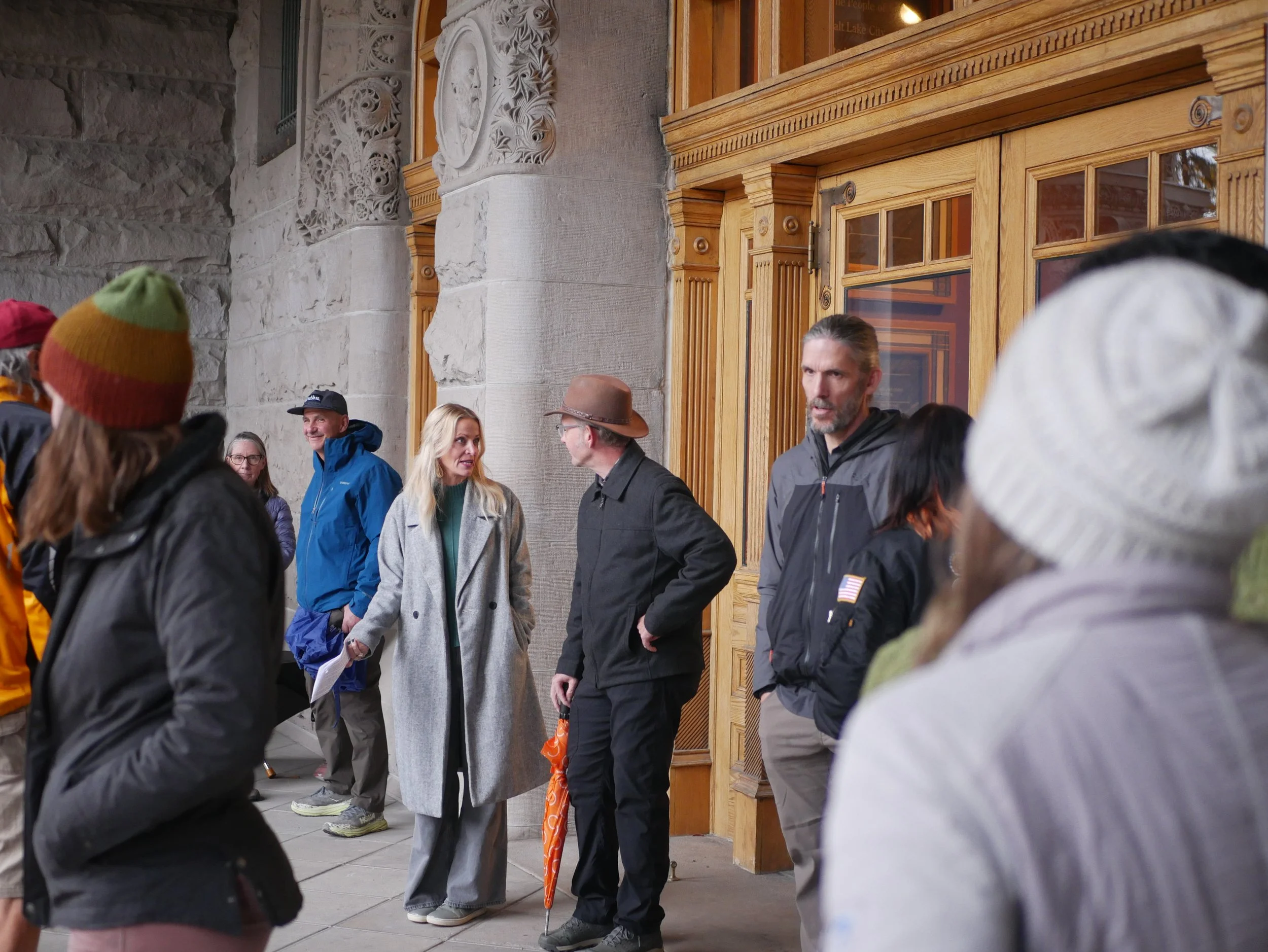
Salt Lakers begin gathering in the alcove of the City and County Building before the start of the speaker program.
On November 16, Salt Lakers came together on a rainy Sunday in Washington Square Park to remember the lives lost to traffic violence and the immense impact it has had on our community. With the rain falling, community members huddled under the alcove of the City and County Building surrounded by beautiful architecture, mature trees, and the sound of rain. Yet, with streets that are effectively highways on all sides of the park, the noise (and danger) of the city’s car-dominated landscape lingered in the distance. Just this year, two lives were lost along the park’s block faces. But Salt Lakers were not alone on this day. Just over the mountains to the south in Provo, our neighbors with BikeWalk Provo were holding an event simultaneously, and communities all over the world hosted events, including over 75 in the United States alone. People are speaking up for safer streets.
The Salt Lake speaker program was kicked off by Sweet Streets’ Julian Jurkoic, who reminded us that we’re all impacted by traffic violence, whether from the loss of a loved one, a friend of a friend, or even just the simple fear to cross the street, which greatly impacts our mobility. Julian continued speaking about our country’s car culture, which has numbed our response to the frequent news of traffic violence, such as the 12 neighbors that have lost their lives right here in Salt Lake City streets this year. He encouraged the crowd not to bear all of this weight on their shoulders, but to take a piece of the shared responsibility and speak up about street safety—to your family and friends in casual conversation, to your city officials and elected representatives.
Next, Micki Harris, the organizer of Cottonwood Heights organization Save Not Pave and traffic violence victim, shared her story. Her 92 year old grandma was struck and killed by a driver when she was using a crosswalk in Apline, Utah 8 years ago. While tragic for Micki and her family, she also noted the impact it had on the driver, a mother who was accompanied by her daughters who witnessed traffic violence right before Christmas. They of course had no intention of killing someone’s grandmother on their way to Christmas shopping, but our society and car-dependent culture has made this risk a regular part of our lives, and there’s always a chance our lives are changed traumatically just by transporting ourselves. Micki had also lost a close friend, who was struck and killed by a driver while cycling. Tragically, and not unlike many crashes, her friend did not pass immediately, and her husband and five children had to pray from the hospital waiting room for what was likely the longest nine hours of their lives to hear the news that no one wants to hear.
If that wasn’t enough, Micki’s husband Matt was also a victim of traffic violence. Matt’s father was a highway patrolman and was responding to a call about a speeding driver in a Corvette on the highway. While attempting to catch up to the driver, he hit a patch of gravel, resulting in a crash that ended his life, leaving behind his wife and four kids. Matt wanted to remind community members about the impacts on first responders, not only the risk they take when stopping on the dangerous shoulder of a highway, but also the mental toll on those responders at the scene of the crash and attempting life-saving care.
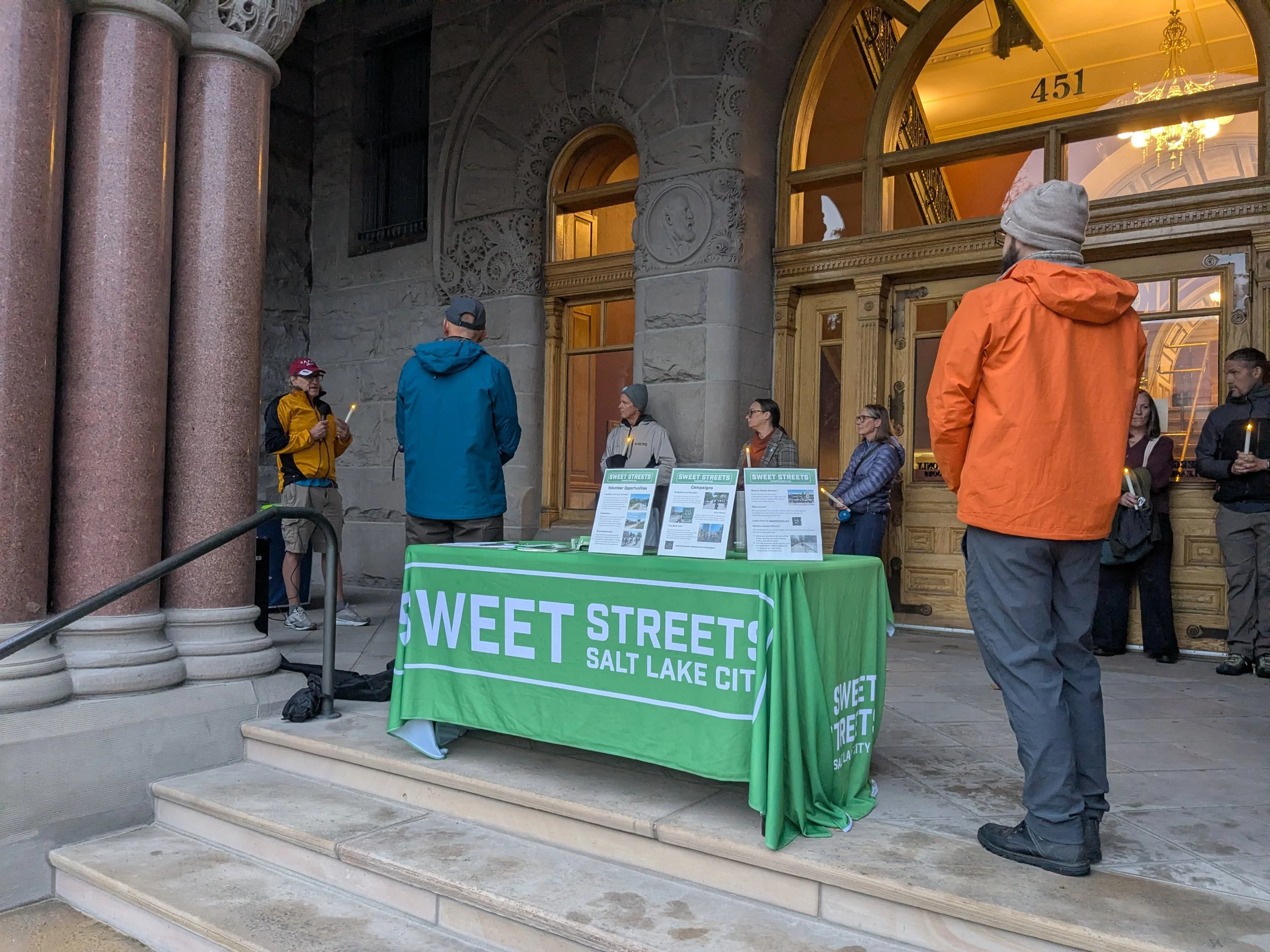
Dave Iltis speaks to his experience with traffic violence and his continued advocacy for safety over the years.
Dave Iltis of Cycling Utah is also a victim of traffic violence. Dave first shared the story of Josie Johnson, who he didn’t personally know, but whose death was the catalyst for the formation of a statewide bicycle coalition. Josie was struck from behind and killed while cycling in Big Cottonwood Canyon. The driver may have had a mini-stroke causing a brief lack of consciousness. The bicycle coalition is now known as Bike Utah, which Dave served on the board for about a decade. Dave’s advocacy was partially inspired from when a driver hit him while he was in a crosswalk on 7th East in 1998, resulting in injuries which turned his life upside down. Dave has published many stories of crashes over the years, serving as reminders to why he has been relentlessly advocating for bicycle safety for nearly three decades.
Following traffic violence stories from the community, Julianne Sabula, interim director of Salt Lake City Transportation, spoke to the crowd. As she grew up, she wondered, listening to the news on the radio, how bizarre it was that the traffic report would speak of a crash, not as a tragic event with widespread impacts on the community, but in terms of what street to avoid so commuters could get to work faster. As part of the work SLC transportation has been doing, they’ve been trying to make our streets safer with designs more appropriate for the speed limit; better, more intuitive construction sites during roadwork; and building with the assumption that people will make mistakes on the road.
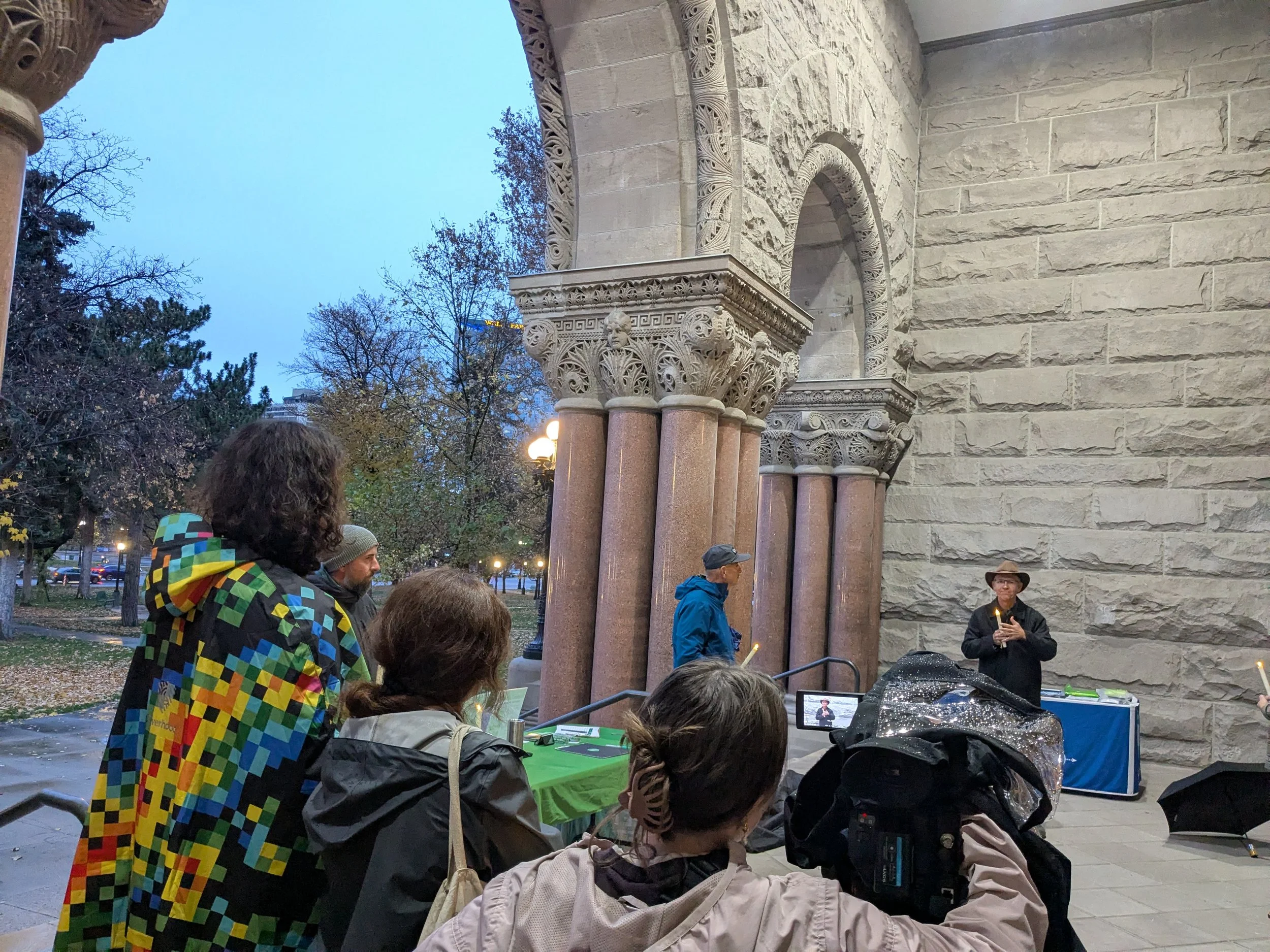
Eric Kraan emphasized the need for shifts in culture and planning to truly combat traffic violence.
The speaker program was concluded by Eric Kraan, who was representing Vision Zero, Utah. He spoke to how transportation is only a piece of the issue. The approach instead needs to be more holistic in terms to the planning and design of our communities. Car-culture is greatly influenced by our building patterns and lack of neighborhood centers or villages, which traditionally have provided our basic needs - a grocery store, a couple of shops and restaurants, a doctor, a bar, etc. For many, these basic services may be a few mile drive away, or are inaccessible to any mode of travel except by car. Eric continued by shifting towards the current culture of blame. By focusing narrowly on a simple action - the pedestrian was not in a crosswalk, the driver was not paying attention, and etc., we’re missing out on all of the other factors that made the crash inevitable in the first place. We must re-center safety and rebuild our communities so that they work for us, not against us.
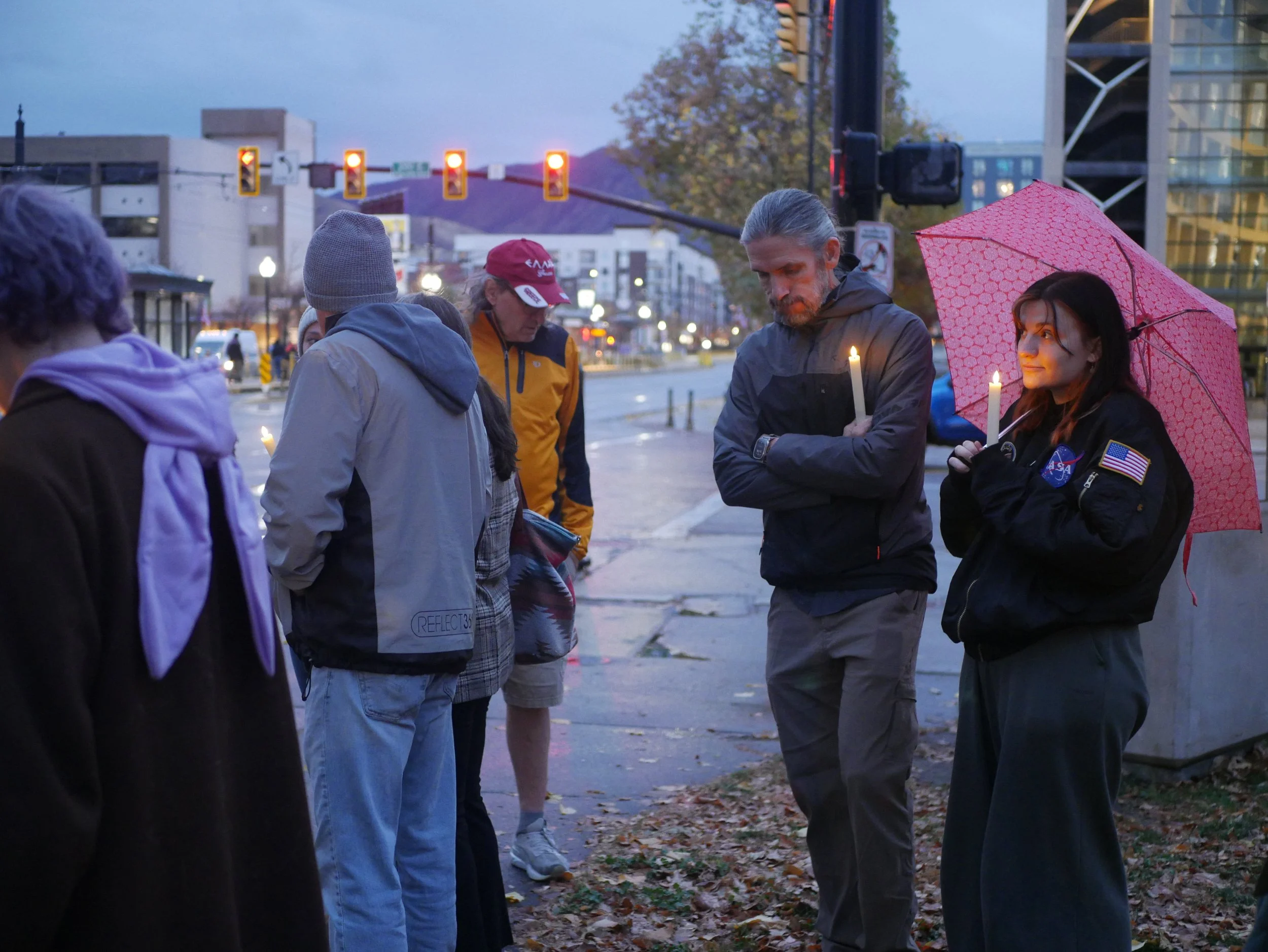
Salt Lakers gather at 400 South and 200 East in a moment of silence to remember all of those who have been lost to traffic violence in our community.
Following the speaker program, attendees walked over to the northeast corner of the park by 400 South and 200 East to hold a candlelight vigil near where a pedestrian was struck and killed earlier this year. The pedestrian was struck by a driver in the overnight hours of May 2 and the driver fled the scene, leaving the victim in the street until the victim was eventually found and paramedics attempted life saving care. This story is one of unfortunately many, and the community took a moment of silence to remember the lives lost or impacted this year and beyond.
As Salt Lakers gathered this rainy November day, the anti-street-safety legislation, the 2025 Utah Legislative session’s SB195, loomed overhead. However, with many of Salt Lake City’s big street reconstructions complete, more people are getting around how they choose to, and with enhanced safety on these newly improved streets. There is momentum to continue fighting so that no one else has to die simply by trying to get where they need to go. And we need to, otherwise the writing is on the wall, and we know this is a challenge, but it is a solvable one. No one needs to die on our streets. We must slow down our urban streets, we must rebuild neighborhood centers and our communities, and we must provide alternatives to car-travel. Being able to get around safely by the mode of your choosing is true freedom.